Saint of the day
Each day, the Catholic Church invites us to remember the saints who have gone before us and who now share in the glory of God. Their lives are a living testimony of faith, courage, charity, and fidelity to Christ.
In this section, we present the Saint of the Day, offering a brief reflection on the life, virtues, and mission of a saint celebrated by the Church. May their example inspire us to grow in holiness, to deepen our love for God, and to follow Christ more faithfully in our own lives.
May the saints intercede for us and guide us on our journey toward Heaven.
29 August 2026
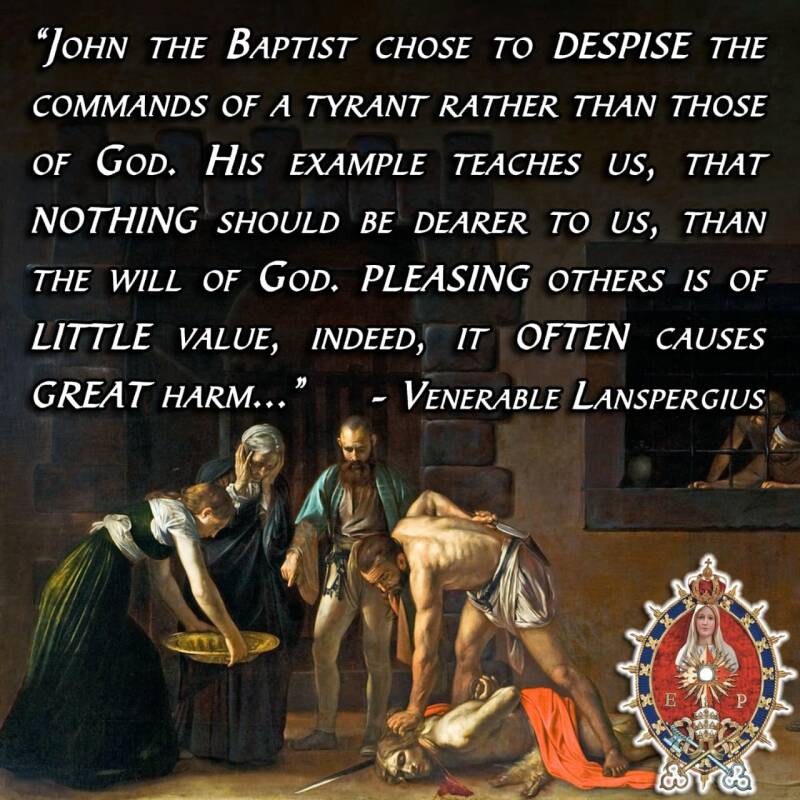
Today, Holy Mother Church triumphantly celebrates the Feast of the Martyrdom of Saint John the Baptist!
As the “greatest born of women,” the Precursor whose leap in the womb heralded the Incarnation, the Baptist was destined to precede the Redeemer not only in birth and preaching, but also in death.
The great liturgist Dom Prosper Guéranger reminds us that St. John the Baptist, having seen the Bridegroom arrive, had only to decrease so that the Son of God might increase. This "decreasing" reached its glorious consummation in the dark dungeons of Machaerus, where Herod the tyrant thought that the light of God’s holy prophet could be extinguished by a sword, only to blaze forth eternally as a beacon of uncompromising fidelity!
The Fathers and Doctors of the Church marvel at the specific nature of the Baptist’s martyrdom. As Saint Bede the Venerable so profoundly teaches in his homilies, John was not explicitly commanded to deny Christ by name, nor was he forced to offer incense to pagan idols. Rather, he was imprisoned and slain because he refused to remain silent in the face of grave moral evil. To King Herod, a man ensnared by his own passions, John spoke the simple, unyielding truth: "It is not lawful for thee to have thy brother's wife." Because Christ Himself said, "I am the Truth," St. Bede concludes that in shedding his blood for the truth of the moral law, Saint John truly shed his blood for Christ – the Truth. He preferred the dampness of the prison cell and the executioner's blade to the comfortable, cowardly silence of compromise.
In his magnificent reflections on this feast, Dom Guéranger contrasts the miserable weakness of Herod (a ruler shackled by human respect, vanity, and lust) with the supreme, unconquerable courage and uprightness of the Baptist in chains. St. John knew that accommodating sin would be a betrayal of the divine mandate of prophetism that he bore. By submitting his neck to the sword, he refused to let the truth be diluted by worldly conveniences or the fear of men.
Furthermore, as Dom Guéranger affirms, St. John's martyrdom was a glorious descent into Limbo to announce to the waiting souls of the Patriarchs and Prophets that the dawn of their redemption was finally at hand.
Let us draw immense courage from the glorious martyrdom of Saint John the Baptist.
In an age that continually pressures us to soften the demands of the Gospel and to compromise the moral law for the sake of societal approval, the Precursor stands as an immovable pillar of fortitude. Let us ask his powerful intercession to obtain for us the grace of holy intransigence. May we never exchange the truth of Christ for the fleeting favours of this world, but rather, like Saint John, be found faithful unto the very end, ready to endure all things for the love of the Truth.
28 August 2026
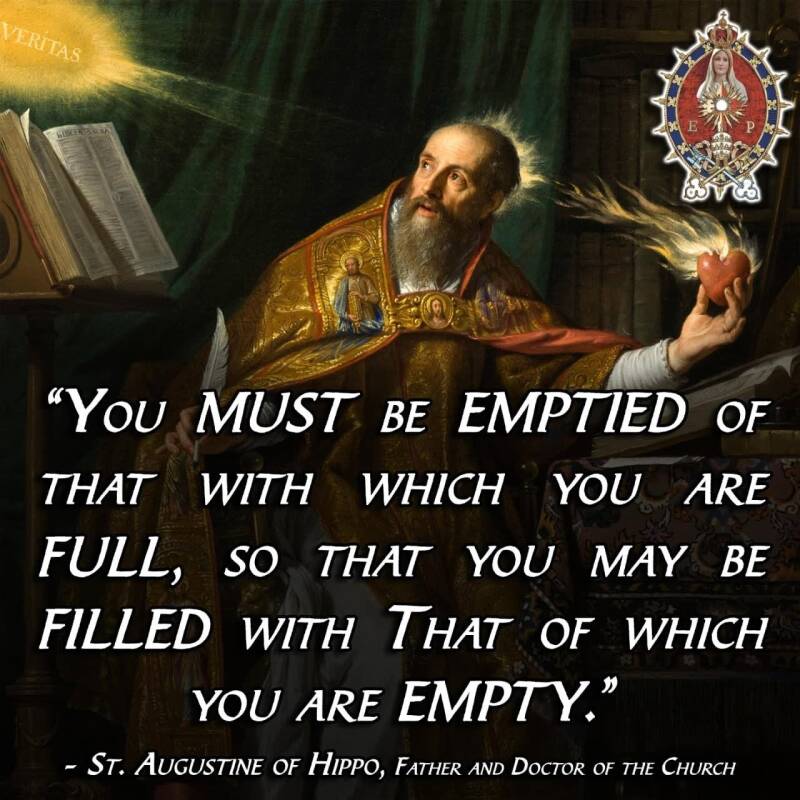
Today the Church celebrates the Feast of St. Augustine of Hippo, Father and Doctor of the Church!
Born in 354 AD in the North African town of Thagaste (modern-day Algeria), Saint Augustine was blessed with a brilliant intellect and a devout Christian mother, Saint Monica, whose relentless prayers would echo through his entire life. Despite her early instruction, the young Augustine plunged into a life of intellectual pride and sensual indulgence while studying rhetoric in Carthage. In his famous spiritual autobiography, the Confessions, he poignantly recalled a childhood escapade of raiding a neighbour’s pear tree — not out of hunger, for the fruit was fed to swine, but for the sheer thrill of doing what was forbidden. Enamoured with worldly success and drifting through philosophical systems like Manichaeism, his divided heart was captured by his famously candid early prayer: "Lord, make me chaste, but not yet!"
Yet God's grace pursued the restless man across the Mediterranean to Rome and Milan, where he encountered the eloquent preaching of Bishop Ambrose. Ambrose’s allegorical exposition of Scripture dismantled Augustine’s intellectual objections, while Monica continued to weep and fast for her son's soul, prompting a bishop to famously comfort her with the words, "It is impossible that the child of such tears should perish." The decisive moment came in the late summer of 386 AD in a Milanese garden. Weeping bitterly under a fig tree over the bondage of his sins, Augustine heard the melodious voice of a child singing in a nearby house: "Tolle, lege! Tolle, lege!" ("Take up and read! Take up and read!"). Interpreting it as a divine command, he picked up the epistles of Saint Paul and opened at random to Romans 13:13–14: "Not in rioting and drunkenness... but put on the Lord Jesus Christ." In that instant, as he later wrote, the darkness of doubt vanished, and an inflowing light of certainty flooded his soul.
Following his baptism by Ambrose at Easter in 387 AD, Augustine returned to North Africa with the intention of leading a quiet, monastic life of prayer and study. However, God called him to public pastoral service, and he was soon ordained a priest and eventually consecrated Bishop of Hippo Regius in 395 AD. For thirty-five years, he shepherded his flock with tender pastoral care while penning foundational works that shaped Western thought, such as! The City of God and On the Trinity.
In 430 AD, as the Germanic Vandals laid siege to the city of Hippo, the seventy-five-year-old bishop fell mortally ill. In his final days, he asked that David’s penitential psalms be copied in large letters and affixed to the walls of his bedchamber, spending his last hours weeping and praying in solitude.
27 August 2026
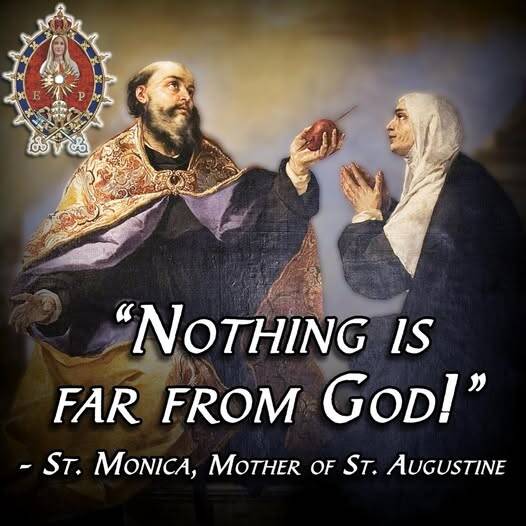
Today we celebrate the Feast of the holy mother of St. Augustine, St. Monica!
Born around 331 AD in Tagaste (modern-day Algeria), Saint Monica was raised a devout Christian. As a young woman, she was given in marriage to Patricius, a pagan Roman official known for his fiery temper and sinful habits. Living under the same roof as a sharp-tongued mother-in-law, Monica faced a turbulent domestic life. Rather than responding with hostility, she adopted a practice of quiet humility, charitable patience, and persistent prayer. In her early married life, when other wives in town complained about their husbands' tempers, Monica playfully reminded them that a gentle tongue and loving restraint were far more powerful than arguments. Her virtuous life eventually softened her household; both her mother-in-law and Patricius embraced Christianity shortly before his death in 371 AD.
While her husband’s conversion was a victory, Monica’s greatest cross proved to be her exceptionally brilliant but headstrong eldest son, Augustine. Rejecting his mother’s faith, Augustine led a dissolute lifestyle in Carthage, embraced the Manichaean heresy, and fathered a child out of wedlock. Heartbroken yet resolute, *Monica wept, fasted, and prayed for her son for over 17 years!*
When Augustine attempted to escape her spiritual vigilance by secretly boarding a ship for Italy under cover of night, a distraught Monica followed him across the Mediterranean Sea. Seeking solace from a wise bishop during this agonizing period, she was comforted by his famous and prophetic words: "Go away now; it is impossible that the son of such tears should perish."
Monica’s relentless intercession bore extraordinary fruit in Milan. There, she formed a deep spiritual friendship with Saint Ambrose, whose powerful preaching and noble character shattered Augustine's intellectual resistance to the Gospel.
*In the spring of 387 AD, Monica experienced the supreme joy of seeing Augustine baptized alongside his son, Adeodatus.* Shortly after, while preparing to return to North Africa, mother and son sat together by a window overlooking a garden at the port of Ostia. There, they shared a famous mystical experience (which is recorded movingly in Augustine's _Confessions_)where their conversation ascended past the stars to touch eternal Wisdom itself. Deeply fulfilled, Monica remarked to her son that *nothing on earth held any further attraction for her, as her life's singular goal had been granted!*
Days after this vision, Monica fell ill with a fever and passed away at the age of fifty-six. When her sons worried about burying her far from her homeland, she famously reassured them: -"Nothing is far from God, and I need not fear that He will not know where to raise me up at the end of the world."_ Today, this saintly wife and mother is venerated as the patron saint of Catholic mothers and wives, and a powerful intercessor in difficult marriages.
26 August 2026
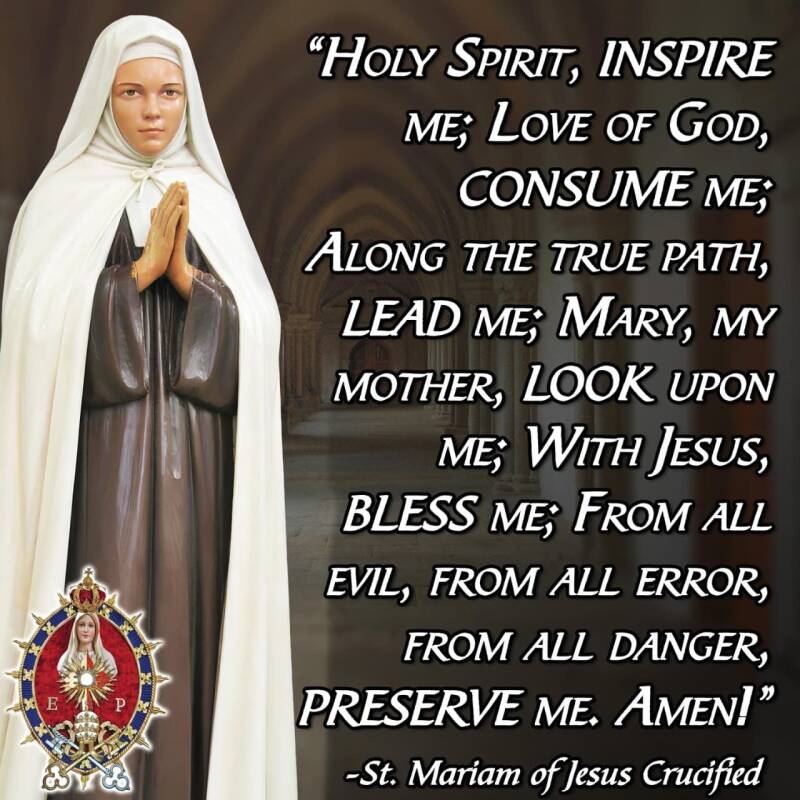
Today the Church celebrates the Feast of St. Mariam of Jesus Crucified - The "Little Nothing" of Carmel, who has a singular link with India!
Saint Mariam Baouardy, known in religion as Sister Mariam of Jesus Crucified, was born in 1846 in Ibillin, a small village in Galilee, to a Melkite Greek Catholic family. Her parents had lost twelve infant sons prior to her birth, and in their grief, they undertook a barefoot pilgrimage to the Grotto of the Nativity in Bethlehem to pray for a daughter, promising to name her Mary. Mariam was born nine months later, but tragedy struck early when both her parents died within days of each other when she was just three years old. Raised by an uncle who later moved the family to Alexandria, Egypt, Mariam faced a harrowing trial at age twelve when she refused an arranged marriage, desiring to give her life entirely to God. Enraged by her refusal to renounce her Christian faith and convert to Islam, a Muslim servant in her uncle’s house slashed her throat and left her body in a dark alley. Miraculously, Mariam awoke in a cave being tended by a mysterious woman dressed in blue (whom Mariam identified immediately as Our Lady) who healed her wound, cared for her for four weeks, and foretold her future vocation in the Carmelite Order.
Following her miraculous recovery, Mariam worked as a domestic servant across Alexandria, Jerusalem, Beirut, and Marseilles, carrying out the most humble tasks with profound joy. In 1867, she entered the Discalced Carmelite monastery in Pau, France. Despite being illiterate and suffering from intense demonic harassment alongside extraordinary mystical graces, Mariam’s soul radiated child-like simplicity. She often referred to herself as ”the little nothing" (la petite rien) to emphasize her complete dependence on God’s mercy. During her earthly life she received the stigmata, experienced prophetic visions, and was frequently raptured in ecstasies. In Pau, during an ecstasy of divine love, she was seen levitating high into the branches of a lime tree, balancing effortlessly on slender twigs while singing poetic verses of praise to the Holy Spirit: ”Love is not loved! Love is not known! Creator, make all creatures praise Thee!"
Driven by an ardent apostolic zeal, Mariam became a key figure in expanding the Carmelite Order to Asia and the Middle East. In 1870, she traveled with a small group of nuns to found the first Carmel in India, at Mangalore! Later, guided by inner visions, she led the establishment of the Carmel of Bethlehem on the Hill of David—the very city where her parents had prayed for her birth. Throughout her spiritual journey, Mariam placed immense emphasis on devotion to the Holy Spirit, urging the Church and individual believers to invoke the Spirit for light, peace, and renewal. She died on August 26, 1878, at the young age of thirty-two, from gangrene resulting from a fall while assisting workmen with the construction of the Bethlehem monastery.
Canonized in 2015, Saint Mariam of Jesus Crucified remains a powerful intercessor and an enduring model of profound humility, heroic forgiveness, and childlike trust in divine providence.
25 August 2026
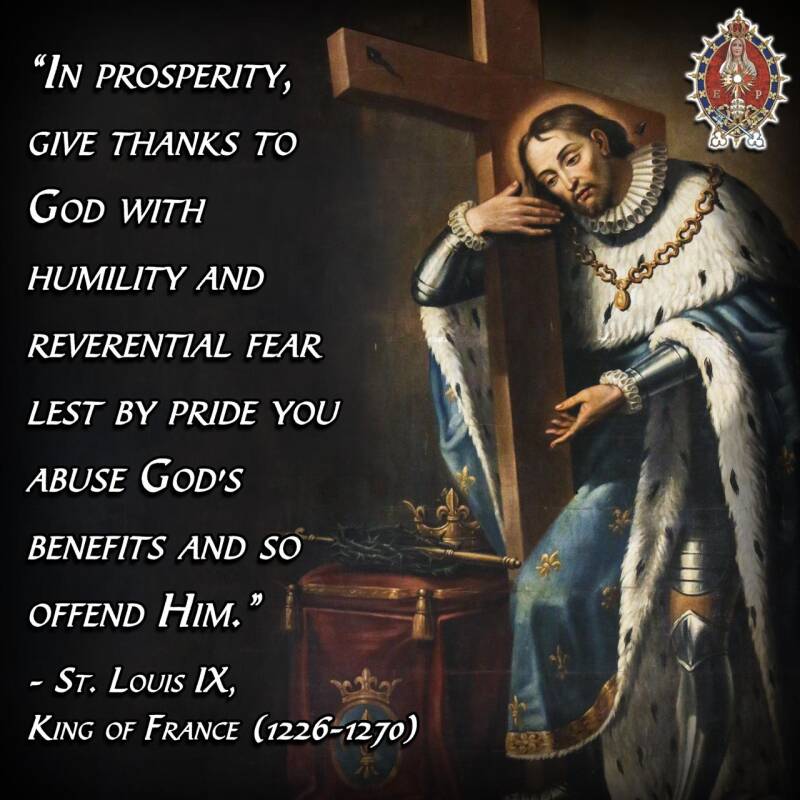
Today the Church commemorates the Feast of St. Louis IX, King of France.
Crowned at just twelve years old following the sudden death of his father, King Louis’s character was forged under the spiritual tutelage of his mother, Queen Blanche of Castile.
She famously impressed upon the young prince the guiding maxim of his life: "I love you, my dear son, as much as a mother can love her child; but I would rather see you dead at my feet than see you commit a single mortal sin!" These watchwords were engraved profoundly on King Louis’ soul. Even at the height of his royal power, he arose at midnight to chant the Divine Office, wore a hidden hairshirt beneath his royal furs, and spent hours listening to grievances beneath the great oak tree at the Bois de Vincennes, ensuring that peasant and nobleman received their due justice.
His profound interior piety manifested most dramatically in 1239 upon the arrival of the Holy Crown of Thorns, which he had redeemed from the Venetian creditors of the Latin Emperor Baldwin II. When the chest reached France, the king stripped off his royal diadem and embroidered robes, donning only a simple, unbelted linen tunic. Barefoot over miles of rough, stony ground, weeping tears of compunction, Louis carried the heavy reliquary on his shoulders alongside his brother Robert into the city of Sens and onward to Paris. To house this relic, he commissioned the Sainte-Chapelle — a Gothic masterpiece designed not merely as a royal chapel, but as a radiant reliquary of stained glass and soaring stone, built to house Our Lord’s crown in celestial light.
Louis’s devotion was equally evident in his love for the poor and the suffering. Rejecting the aloofness of the courts, he personally washed the feet of the destitute each Saturday, fed hundreds of beggars from his own table, and tenderly washed and bandaged the sores of lepers whom courtiers refused to approach. In governance, he reformed the French legal system by abolishing trial by combat, curbing royal corruption, and establishing the presumption of innocence. When his life ended during the Eighth Crusade outside Tunis in 1270, his humility remained unbroken. Requesting to be lifted from his bed and laid upon a cross of ashes spread across the ground, Louis crossed his arms over his chest and breathed his last with the words: "Lord, I will enter into Your house; I will worship toward Your holy temple and praise Your name."
24 August 2026
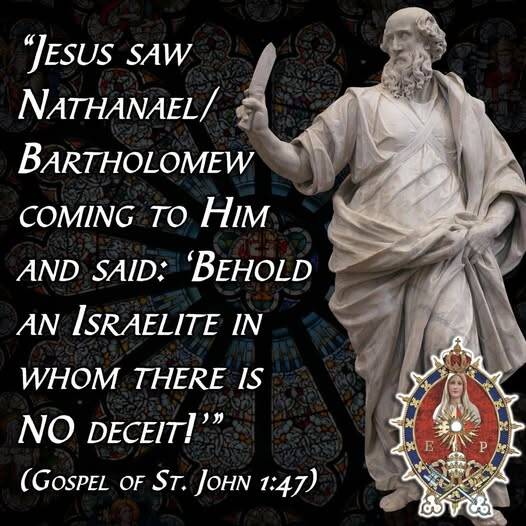
Today the Church celebrates the Feast of St. Bartholomew!
Saint Bartholomew, identified in Church tradition with Nathanael of Cana, entered the apostolic circle through the invitation of Saint Philip. Initially sceptical of the Messiah's humble Galilean origins (famously asking, "Can anything good come out of Nazareth?"), his perspective shifted instantly upon encountering Our Lord Jesus Christ. Our Lord commended him as "an Israelite indeed, in whom there is no deceit," revealing that He had seen Nathanael beneath the shade of a fig tree before Philip even called him. Overwhelmed by this display of divine insight, Bartholomew made one of the earliest and most decisive confessions of faith recorded in the Gospels: "Rabbi, you are the Son of God; you are the King of Israel!"
Little is it known that following the Pentecost, St. Bartholomew carried the Gospel across the ancient Near East, traversing Mesopotamia, Persia, and regions of India! His mission in India took him along the thriving maritime trade routes of the Arabian Sea to the western coast of the Indian subcontinent, specifically the region of the Konkan coast and the ancient port city of Kalyan (near modern-day Bombay).
The early Church historian Eusebius notes that when the Christian scholar Pantaenus visited India in the second century, he found an established community still reading from a Hebrew copy of the Gospel of Matthew that Bartholomew had left behind! Hagiographical records, notably recorded in the _Golden Legend,_ recounts how he cured the afflicted daughter of King Polymius, entirely renounced the royal treasures offered in gratitude, and guided the king along with thousands of subjects to baptism.
St. Bartholomew's unwavering zeal ultimately met fierce resistance from the pagan establishment. At the instigation of Polymius’s hostile brother, King Astyages, Bartholomew was arrested at Albanopolis and sentenced to be flayed alive (skinned alive) before his beheading. His martyrdom cemented his legacy as a model of extraordinary Christian fortitude. In sacred art, he is distinctively depicted bearing his own flayed skin alongside a tanner’s knife. Today, he is celebrated worldwide as the patron saint of tanners, bookbinders, and leatherworkers.